Your dryer is running, the drum is spinning, but the clothes come out just as wet as they went in and nobody wants to deal with that, especially on laundry day. This guide will walk you through the most common reasons a dryer stops heating, what you can check yourself, and when it makes sense to call in a professional.
Here in Abbotsford, our damp climate means the dryer gets a real workout especially through the fall and winter months when line drying outside just isn’t realistic. A dryer not heating isn’t just an inconvenience; it can throw off your whole household routine. At Abbotsford Appliance Repair Pros, we see this problem regularly, and the good news is that many of the causes are surprisingly straightforward once you know what to look for.
That said, some fixes are genuinely DIY-friendly, and others are best left to someone with the right tools and training. The goal here is to help you figure out which category your situation falls into so you’re not wasting time on simple checks when there’s a bigger issue, and not calling for service when you could have solved it in five minutes.
Key takeaways
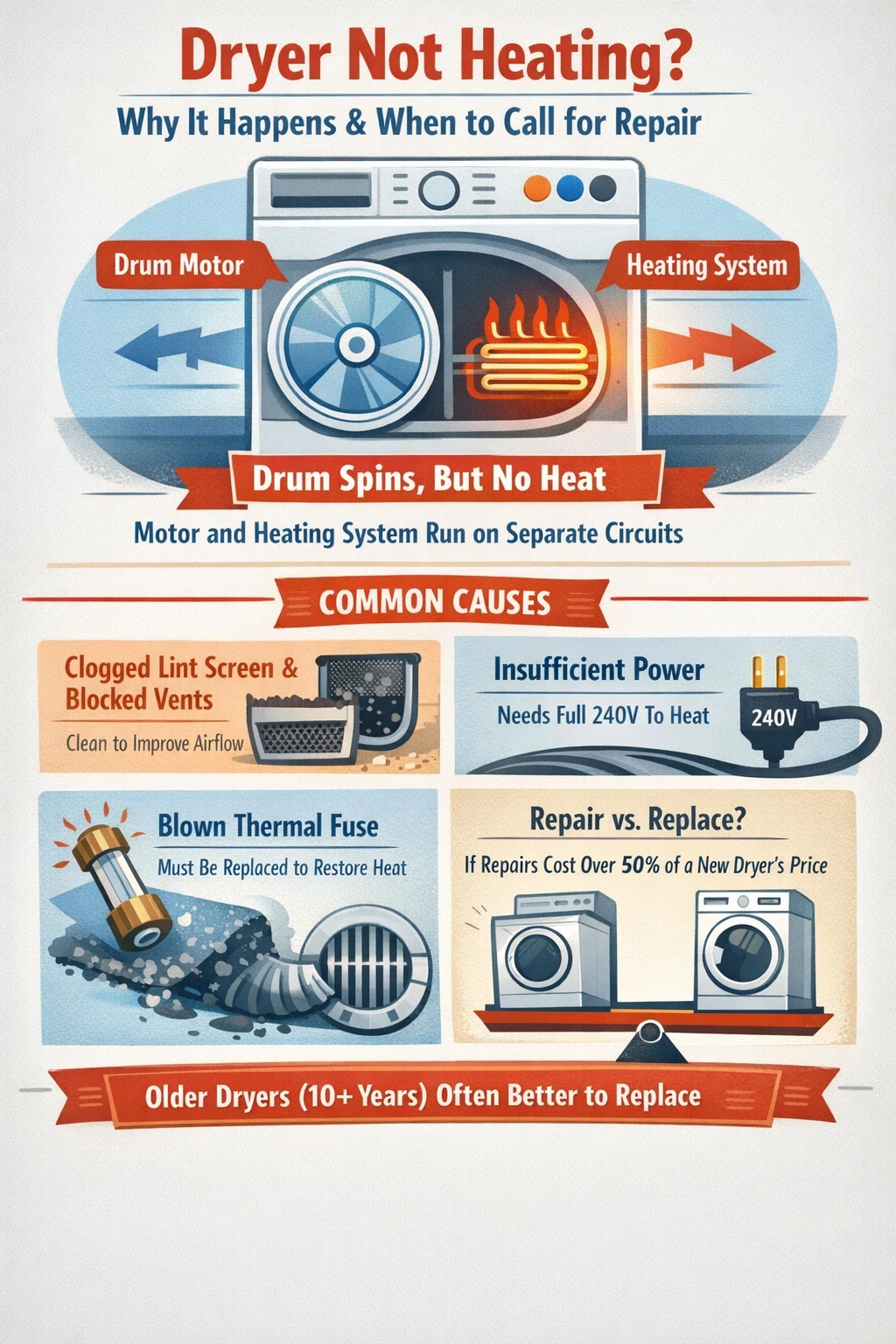
- A dryer can spin normally without producing any heat, because the drum motor and heating system run on separate circuits.
- Clogged lint screens and blocked vents are the most common causes of poor drying performance, and both can be fixed without tools.
- Electric dryers require a full 240-volt power supply if only one leg of the circuit is working, the drum may spin but the heater won’t activate.
- A blown thermal fuse is a one-time safety device; it cannot be reset and must be replaced before the dryer will heat again.
- Dryer vents should be cleaned at least once a year, and more often in high-use households blocked vents are the leading cause of both heating problems and dryer fires.
- If a repair would cost 50% or more of what a new dryer costs, replacement is usually the smarter move, especially on a machine that’s more than 10 years old.
Why your dryer isn’t heating
The short answer: the drum and the heating system are two separate things. Your dryer can spin all day on a partial electrical connection or with a tripped safety component, while producing zero heat. So a tumbling dryer that isn’t actually drying anything is a very specific kind of problem not a general “the dryer is broken” situation.
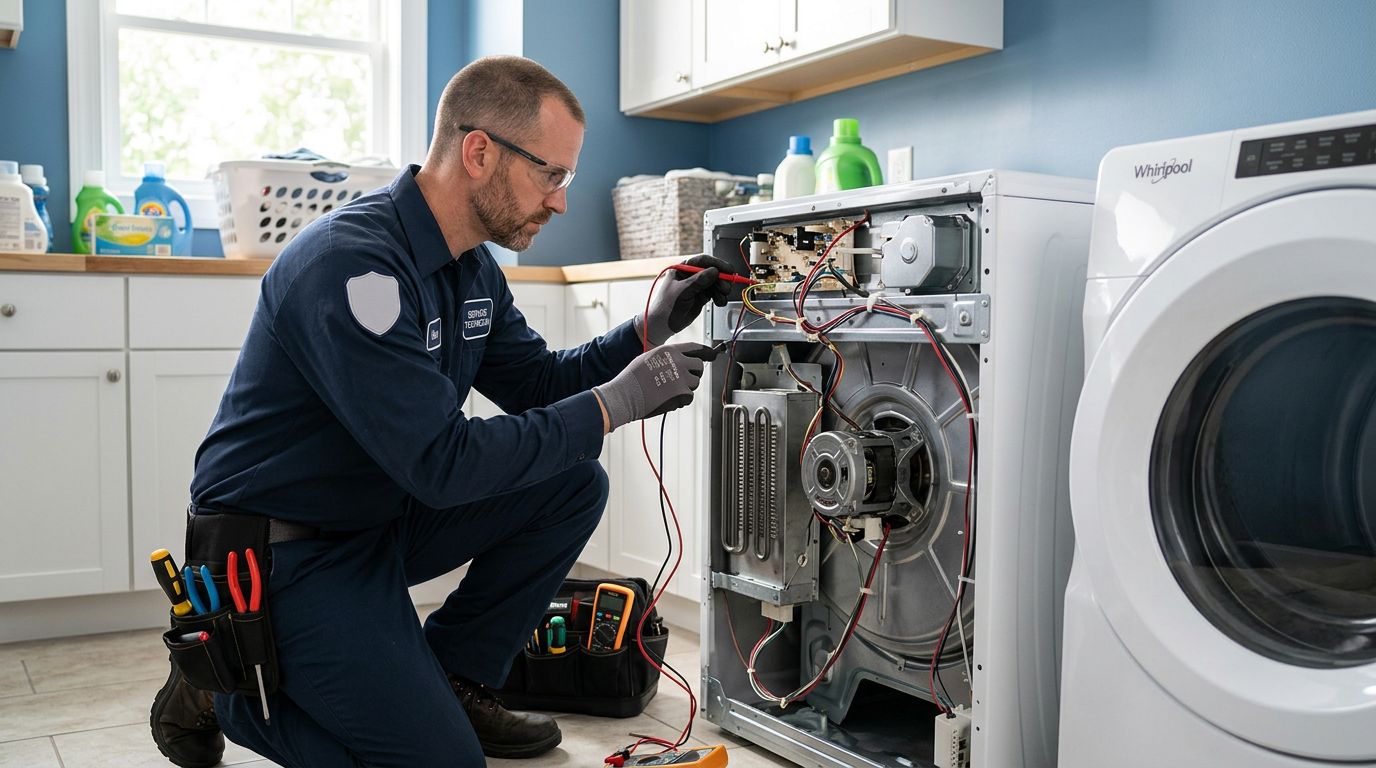
There are really two categories to think about here. The first is a true heating failure, where the dryer genuinely isn’t producing warm air at all. The second is poor drying performance, where there is some heat but clothes are still coming out damp after a full cycle. Both are frustrating, but they point to different causes. A completely cold dryer usually means a blown thermal fuse, a failed heating element, a power supply issue, or a closed gas valve. A dryer that heats but doesn’t fully dry is more often a ventilation or load-size problem.
In our experience, people often assume something expensive has broken when the actual issue is a clogged vent or a lint screen that hasn’t been cleaned in months. Start with the simple stuff before you assume the worst.
The easy checks start here before anything else
Before pulling the dryer apart or calling anyone, run through these basics. They cost nothing and take maybe ten minutes total.
First, check your lint screen. Pull it out and take a look if it’s covered in a thick grey mat, that’s your first problem. A blocked lint screen restricts airflow, which puts stress on the heating system and can cause the dryer to overheat and shut down. Clean it after every single load, no exceptions. About every six months, give it a deeper clean with a nylon brush, hot water, and a bit of liquid soap, then let it dry fully before putting it back. It sounds like overkill until you realize how much lint actually makes it through.
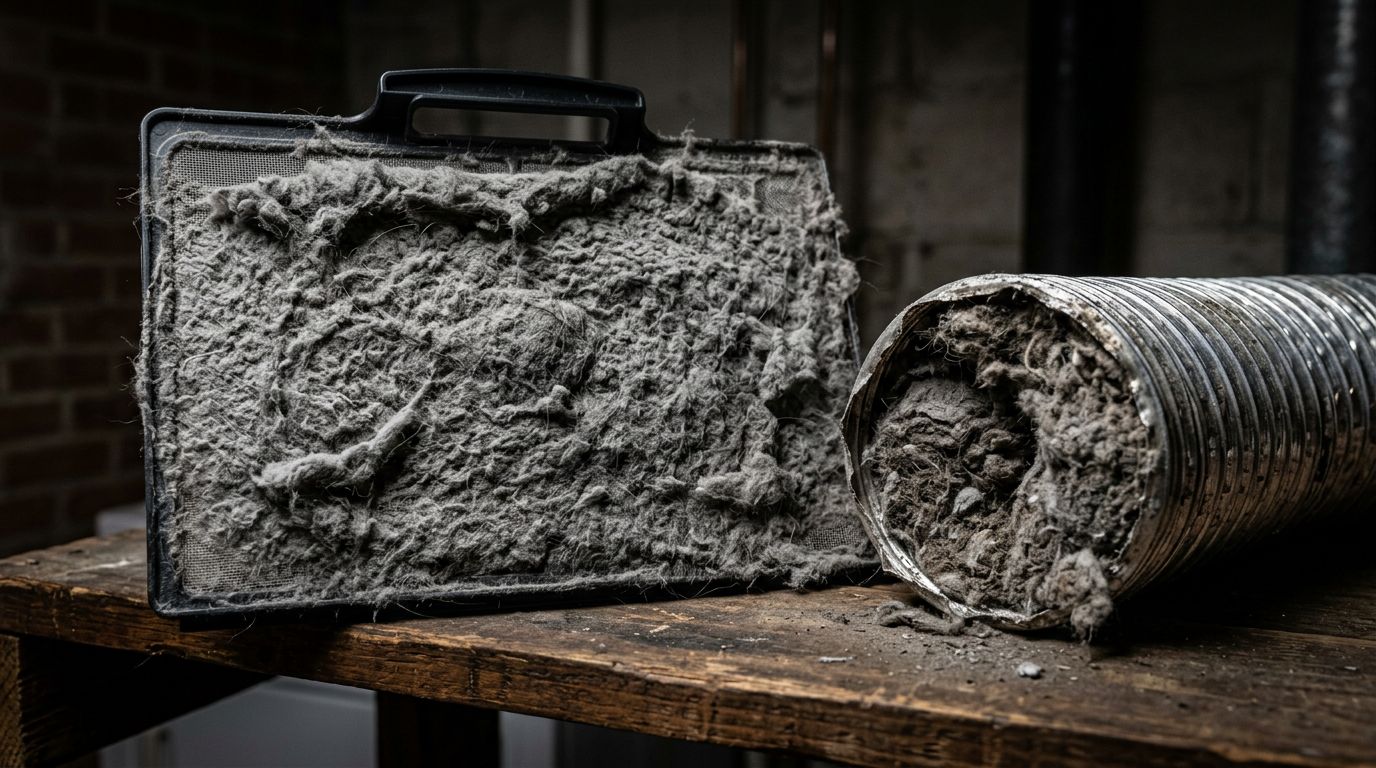
Next, check the vent hose running from the back of the dryer to the outside of your home. If it’s kinked, crushed behind the dryer, or packed with lint, hot moist air can’t escape and your clothes will never fully dry no matter how long the cycle runs. The entire vent run, from the back of the machine to the exterior exhaust hood, should be cleaned at least once a year. Households with kids, pets, or heavy laundry loads probably need it done more often. We get a lot of calls from homes in older Abbotsford neighbourhoods around Clearbrook and Montrose in particular where vents run longer distances through the wall and accumulate lint faster than most people expect.
Also worth checking: load size. Fill the drum to about three-quarters full. Overstuffed loads don’t tumble properly, air can’t circulate, and clothes will stay damp even in a perfectly functioning dryer. And if your clothes came out of the washer absolutely soaking wet, run another spin cycle before transferring them. Very wet clothes overwhelm a dryer’s capacity to handle moisture, which can look like a heating problem when it isn’t.
Power supply problems electric vs. gas dryers
Once you’ve ruled out the simple stuff, power supply is the next thing to look at. This is where electric and gas dryers differ significantly, so it’s worth separating them out.
An electric dryer requires a full 240-volt supply to operate. Here’s the thing that surprises a lot of people: electric dryers run on two separate 30-amp circuit breakers. One breaker runs the motor that spins the drum. The other runs the heating element. If only one breaker trips which happens more often than you’d think the drum will spin normally, but there will be no heat whatsoever. The dryer looks like it’s working, and it technically is, just without the part that matters. Go to your breaker panel, find the double-pole breaker for the dryer, and reset both sides. If it trips again immediately, that’s a sign of a deeper electrical issue and you should call a licensed electrician rather than keep resetting it.
For a gas dryer, the issue is usually simpler. Gas reaches the burner through a supply valve, and if that valve is closed or only partially open, the drum will spin but nothing will heat. Check that the valve handle is parallel to the gas pipe, which means it’s open. If it’s perpendicular, it’s closed. That’s sometimes all it takes. Beyond the valve, gas dryers also have components like igniters and flame sensors that can fail. Any repair that involves the gas line itself should go to a qualified technician this is not an area for guessing.
When the problem is inside the machine
If the easy checks didn’t solve it, and the power supply looks fine, the issue is likely inside the dryer itself. These repairs require disassembling the machine, and they’re generally worth having a professional handle unless you’re comfortable with appliance repair and have a multimeter.
Thermal fuse
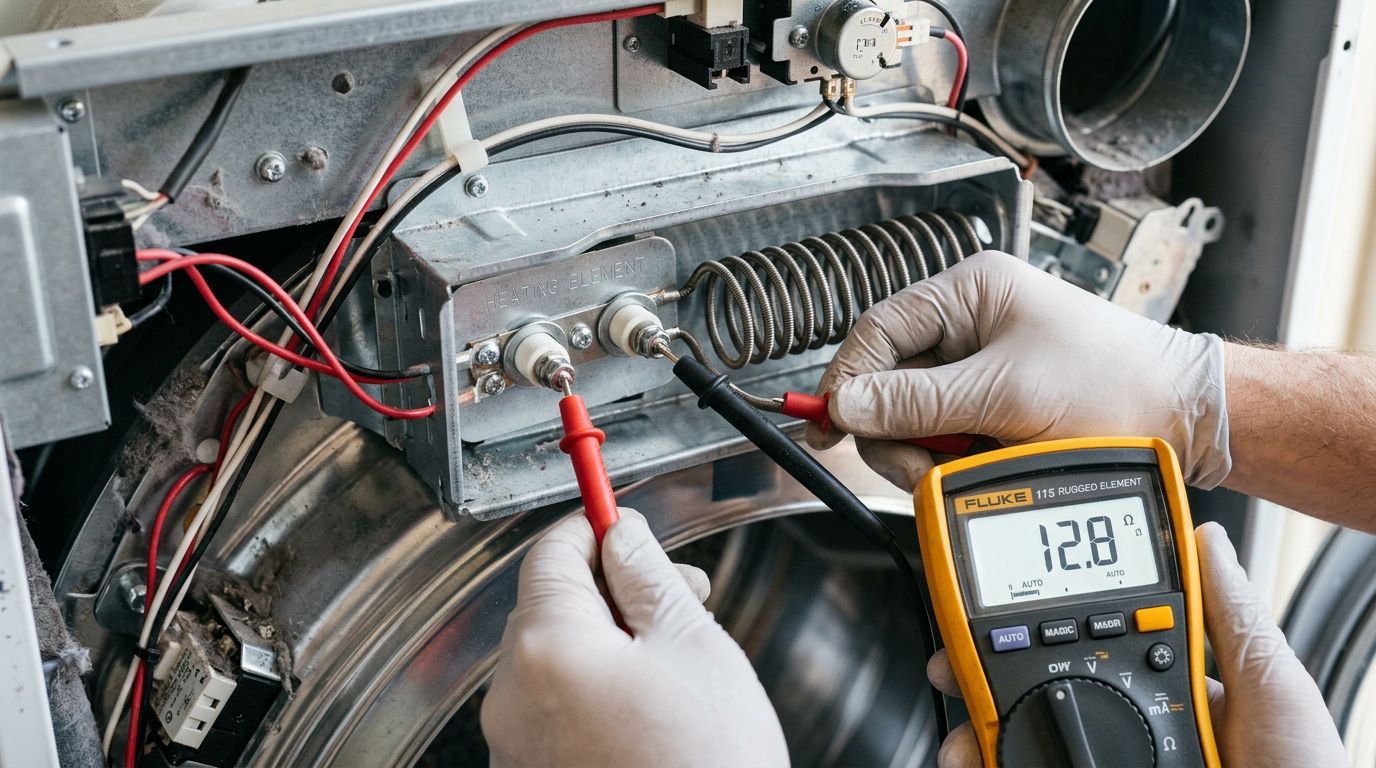
The thermal fuse is a small, inexpensive safety component designed to blow if the dryer overheats. It’s a one-time device. Once it trips, the dryer will not heat again until the fuse is physically replaced. You cannot reset it, and there’s no workaround. It’s usually located near the blower housing or the heating element, and it can be tested with a multimeter no continuity means it’s blown.
Here’s the important part: if your thermal fuse blew, it blew for a reason. Nine times out of ten, it’s because the vent was clogged and the dryer was overheating. Replace the fuse, but also clean the vent otherwise the new fuse will blow too, and you’ll be back to square one.
Heating element (electric dryers)
Electric dryers use a coiled heating element to warm the air inside the drum. Over time, that coil can burn out sometimes due to age, sometimes because restricted airflow caused it to run too hot for too long. A visible break or burn mark in the coil is a clear sign it’s failed. A multimeter test for continuity will confirm it if there’s no obvious damage. Replacement requires removing the back panel of the dryer and handling the element carefully. It’s a manageable repair for someone with some appliance experience, but if you’re not sure what you’re doing, the better move is to call someone who does.
Thermostat issues
Dryers typically have more than one thermostat a cycling thermostat that regulates temperature during a normal cycle, and a high-limit thermostat that cuts power if things get dangerously hot. Either one can fail. A stuck or defective thermostat can cause the dryer to produce some heat but not enough to properly dry clothes, or it can cause the dryer to start heating and then cut out partway through a cycle. Both are testable with a multimeter. A faulty thermostat will show no continuity when tested at room temperature.
One thing we see occasionally in older homes – particularly those in areas like Abbotsford’s west end with original electrical panels – is a combination of a marginal power supply and a marginal thermostat working against each other. Individually, neither problem would necessarily take the dryer out of service. Together, they make the machine nearly useless. That’s the kind of diagnosis that benefits from a professional eye.
Gas dryer heating problems specifically
Gas dryers have a few additional components that don’t exist in electric models. The igniter is what lights the gas to create the flame that heats the air. If the igniter is failing, you might get intermittent heat the dryer works fine for a cycle or two, then stops heating, then works again. A faulty flame sensor has a similar effect, cutting off the gas supply even when the igniter is working correctly.
These parts are testable and replaceable, but working on a gas appliance carries risks that working on an electric one doesn’t. If you smell gas at any point during your troubleshooting, stop immediately, don’t operate any switches, and call your gas utility. For anything beyond the valve check we mentioned earlier, a licensed technician is the right call for gas dryer repair. It’s not worth the risk to save a service fee.
For a broader overview of gas appliance safety in the home, Natural Resources Canada has useful guidance on how gas appliances should be maintained and serviced safely.
When to repair vs. replace
This is the question we get asked most often, and honestly it’s a fair one. A dryer that’s not heating can sometimes be fixed for $50 in parts and an hour of work. Other times, you’re looking at a machine that’s had a hard life and is starting to fail in multiple places.
A useful rule of thumb: if the repair cost would run 50% or more of what a comparable new dryer costs, replacement is usually the smarter long-term choice. A basic residential dryer runs anywhere from $600 to over $1,000 new, so that threshold gives you a reasonable ceiling for what a repair is worth spending. Age matters too. A dryer under eight years old with a blown thermal fuse is almost always worth fixing. A fifteen-year-old machine with a dead heating element, a questionable thermostat, and worn drum bearings is probably telling you something.
If you’re doing the math and it’s not clear, a diagnostic visit from a qualified technician will at least give you an honest answer. The Energy Star program is also worth checking if you’re considering a new machine newer certified models can reduce energy use significantly compared to older dryers, which sometimes makes replacement the better financial decision even when a repair is technically possible.
Frequently asked questions
These are the questions we hear most often from homeowners trying to sort out a dryer not heating. Some have simple answers, and some have answers that depend on what’s actually going on with your specific machine.
Why is my dryer running but blowing cold air?
The drum motor and the heating system are independent, so the dryer can run perfectly fine mechanically while producing no heat at all. The most likely causes are a blown thermal fuse, a failed heating element (in electric dryers), a tripped circuit breaker, or a closed gas valve (in gas dryers). Start with the breaker panel and the gas valve both take two minutes to check. If those are fine, the issue is probably inside the machine.
Can I keep using the dryer if it’s not heating?
Technically, yes it will tumble your clothes and remove some lint. But it won’t actually dry anything. Running wet clothes through repeated cycles hoping for a miracle is a waste of electricity and adds unnecessary wear on the motor and belt. More importantly, if the dryer stopped heating because of a blocked vent or overheating issue, continuing to run it could create a fire hazard. Stop using it, find the cause, and fix it before running more loads.
How do I know if the heating element is bad?
Unplug the dryer first. Remove the back panel (on most models) and look at the heating element inside its metal housing. A visible break, burn mark, or crack in the coil is a clear sign of failure. If there’s no obvious damage, you can test it with a multimeter set to continuity a good element will show continuity, a failed one won’t. If the multimeter reads zero or infinite resistance, it’s time for a replacement. If you’re not comfortable with either step, that’s a perfectly reasonable reason to call a technician.
Why does my dryer start heating and then stop mid-cycle?
This usually points to one of a few things: a partially clogged vent that causes the dryer to overheat and trigger the safety cutoffs, a cycling thermostat that’s worn out, a heating element with a hairline crack that fails once it gets hot, or a faulty moisture sensor that tells the control board to stop heating before the clothes are actually dry. Intermittent heating problems are often trickier to diagnose than total heating failures, because the issue may not be present when a technician first looks at the machine. Describing exactly when and how the heating stops will help narrow it down faster.
Is dryer vent cleaning something I can do myself?
For most homeowners, yes. Disconnect the flexible duct at the back of the dryer, reach in with a dryer vent cleaning brush (available at any hardware store), and work your way through the vent to the exterior exhaust hood. Vacuum out what you can reach. For longer vent runs or vents that haven’t been cleaned in years, a professional vent cleaning service will have the equipment to do a more thorough job. Either way, get it done at least once a year. It’s one of those maintenance tasks that has a real safety payoff, not just an efficiency one. The National Fire Protection Association consistently identifies clogged dryer vents as a leading cause of residential fires.
Wrapping up
A dryer not heating almost always comes down to one of a handful of causes: a ventilation or lint problem, a power supply issue, a blown thermal fuse, or a failed heating element or thermostat. The first two categories are DIY-friendly and worth checking before anything else. The second two usually require opening the machine and, in some cases, professional diagnosis and repair. If you’re not sure where things stand, or if you’ve worked through the basics and still can’t find the problem, that’s exactly when it makes sense to get a technician involved. At Abbotsford Appliance Repair Pros, we handle dryer repair across Abbotsford and the surrounding area along with washers, fridges, stoves, dishwashers, and other household appliances. Give us a call and we’ll help you figure out whether a repair makes sense or whether it’s time to move on to something new.